Key Takeaways
- Value Averaging invests more during market falls and less when markets rise, with a theoretical 0.3%–1% CAGR advantage in volatile markets.
- That approach can require 3–5 times your usual contribution during a crash, which may be difficult to sustain.
- SIPs offer predictable contributions and are easier for most investors to maintain over long periods.
- A Step-Up SIP increases your contribution annually in line with income growth, without requiring market monitoring.
- The best strategy is one you can continue consistently for 15–20 years.
Introduction
SIP is India's most popular investment strategy. But there is a lesser-known alternative called Value Averaging (VA) that academics have championed for decades. Does it beat SIP in the real world? The answer may change how you think about smart investing.
What Is Value Averaging?
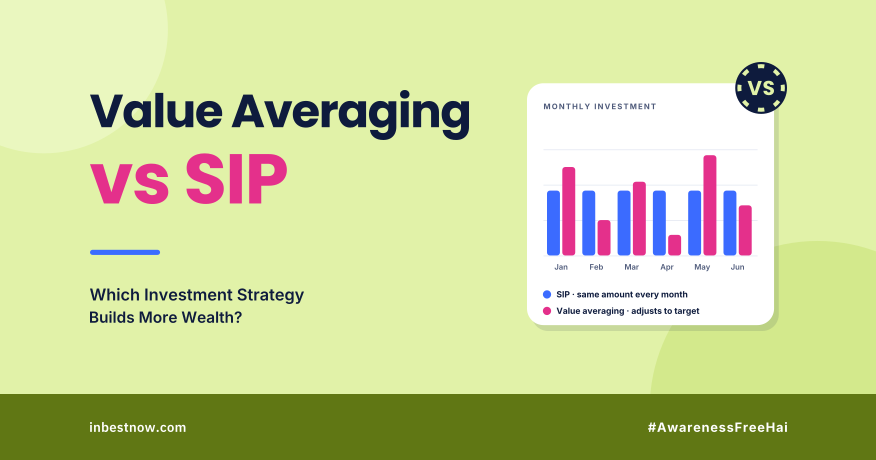
In a standard SIP, you invest a fixed amount every month regardless of market levels. In Value Averaging, you target a fixed growth in your portfolio value each period. If the portfolio grows less than planned because the market is down, you invest more. If it overshoots because the market is up, you invest less or may even sell. The idea is to automatically buy more at lower prices and less at higher prices.
| Feature | SIP | Value Averaging (VA) |
|---|---|---|
| Monthly amount | Fixed every month | Variable, based on portfolio performance |
| When the market falls | Buys more units automatically | Invests more to reach the target portfolio value |
| When the market rises | Buys fewer units | Invests less or may sell |
| Cash flow predictability | High — fixed monthly contribution | Low — contribution needs can be unpredictable |
| Historical edge | Baseline | About 0.3%–1% CAGR advantage in volatile markets |
Why SIP Wins in Practice
Value Averaging can generate marginally better returns in volatile markets — roughly 0.3%–1% extra CAGR. But this comes at a steep cost: during a market crash, VA may demand three to five times your normal monthly investment to stay on target. Most salaried investors simply do not have that liquidity available on demand.
Investors may also be most tempted to abandon Value Averaging during extreme downturns, precisely when the strategy calls for larger contributions. A strategy you maintain for 20 years can serve you better than a theoretically superior strategy you abandon in year three.
The Middle Path: Step-Up SIP
If you want to increase your investments over time without adding complexity, consider a Step-Up SIP. It automatically increases your monthly SIP by a fixed percentage (typically 10%–15%) each year, aligning your investment growth with your income growth without requiring market monitoring.
Key Takeaways
- Value Averaging invests more during market falls and may have a modest theoretical advantage over SIP in volatile markets.
- Variable and potentially large cash requirements during crashes can make Value Averaging difficult to sustain.
- SIP offers simplicity, predictability, and psychological sustainability over long investment horizons.
- Step-Up SIP is a middle ground: investments rise with income, without market monitoring.
- The best strategy is one you can maintain without interruption for 15–20 years. Discipline matters more than sophistication.
Disclaimer
Mutual fund investments are subject to market risks. Please read all scheme-related documents carefully before investing. Past performance is not indicative of future results. Baid Inbest LLP is an AMFI-registered Mutual Fund Distributor (ARN: 86114). This content is for educational purposes only and does not constitute personalised investment advice.
Want a disciplined, sustainable long-term investment strategy? Inbest can design one for you — visit www.inbestnow.com or call +91 9903921999.