Key Takeaways
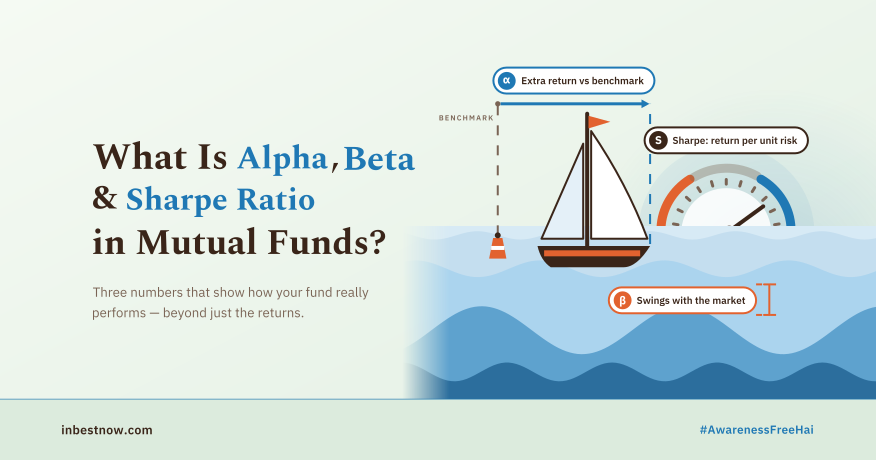
- Alpha tells you if the fund manager is genuinely adding value beyond the benchmark — a consistently positive alpha is the mark of a skilled manager.
- Beta measures how the fund moves relative to the market — lower beta means less volatility; higher beta means more amplified market swings.
- Sharpe ratio measures return efficiency — a fund with a higher Sharpe ratio gives you better returns for the same level of risk.
- Never evaluate funds on returns alone — combine alpha, beta, and Sharpe ratio with rolling return analysis for a complete picture.
- These metrics are available in every fund factsheet and on platforms like Value Research Online and Morningstar India.
Introduction
If you have ever looked at a mutual fund's factsheet and seen numbers labelled ‘Alpha: 2.4,’ ‘Beta: 0.89,’ and ‘Sharpe: 1.12’ — and had no idea what they meant — you are in good company. Most investors skip these metrics entirely. Yet these three numbers can tell you more about a fund's quality than 10 years of return data.
What Is Alpha in a Mutual Fund?
Alpha measures how much extra return the fund manager has generated above the benchmark index, after adjusting for risk. If the Nifty 50 gave a 12% return and your fund gave 14.5%, the fund has generated a positive alpha of approximately 2.5%. A consistently positive alpha means the fund manager is genuinely adding value. A negative alpha means the manager is underperforming after costs. According to AMFI data, only about 30–40% of actively managed large-cap funds consistently generate positive alpha over a 5-year period in India.
What Is Beta in a Mutual Fund?
Beta measures a fund's sensitivity to market movements. Beta = 1.0 means the fund moves exactly in line with its benchmark. Beta > 1.0 means the fund is more volatile than the market — it rises more in bull markets and falls more in bear markets. Beta < 1.0 means the fund is less sensitive to market swings. For conservative investors, a lower beta fund provides a smoother ride. For aggressive investors in a bull market, high beta can boost returns.
What Is the Sharpe Ratio in a Mutual Fund?
The Sharpe ratio measures return per unit of risk taken. It is calculated as: (Fund Return – Risk-Free Rate) ÷ Standard Deviation. A higher Sharpe ratio means the fund is giving you better returns for the amount of risk it takes. A Sharpe ratio above 1.0 is generally considered good. If two funds have the same 5-year return but one has a Sharpe of 1.4 and the other has 0.8, the first fund is more efficient — it achieved the same return by taking less risk.
| Metric | What It Measures | Good Value | Red Flag |
|---|---|---|---|
| Alpha | Excess return over benchmark | Consistently positive (>1.0) | Consistently negative |
| Beta | Market sensitivity | Depends on your risk appetite | >1.5 (very volatile) |
| Sharpe Ratio | Return per unit of risk | >1.0 | <0 (negative Sharpe) |
Disclaimer
Mutual fund investments are subject to market risks. Please read all scheme-related documents carefully before investing. Past performance is not indicative of future results. Baid Inbest LLP is an AMFI-registered Mutual Fund Distributor (ARN: 86114). This content is for educational purposes only and does not constitute personalised investment advice.
Want a complete risk-adjusted analysis of your mutual fund portfolio? Inbest's research team can help — visit www.inbestnow.com or call +91 9903921999.