Key Takeaways
- Sovereign Green Bonds are government-backed securities — zero default risk, same as standard G-Secs.
- They carry a ‘greenium’ — yields are 5–7 basis points lower than equivalent standard G-Secs.
- For purely financial returns, standard G-Secs or RBI Floating Rate Bonds offer better yield for the same safety.
- For ESG-minded investors, the small yield sacrifice funds certified clean energy and climate infrastructure projects.
- Access via RBI Retail Direct Portal — commission-free and designed for retail investors.
Introduction
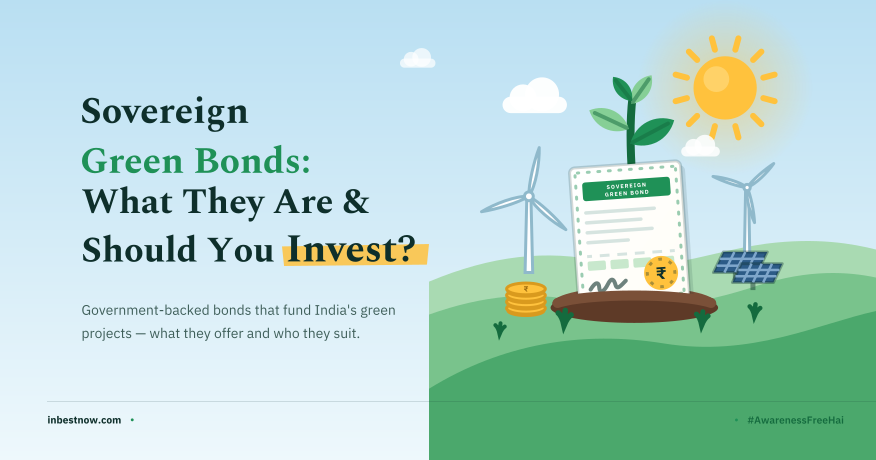
The Government of India issued its first Sovereign Green Bond (SGB) in January 2023, raising ₹8,000 crore to fund green infrastructure — solar power, clean transportation, energy efficiency, and biodiversity conservation. These bonds represent a new intersection of government-backed safety and ESG investing. Here is what Indian investors need to know.
What Are Sovereign Green Bonds?
Sovereign Green Bonds are government securities (G-Secs) issued by the Government of India specifically to fund projects with environmental benefits. They carry the same sovereign guarantee as standard G-Secs — zero default risk. The ‘green’ label certifies that proceeds are exclusively used for approved green projects. India’s Sovereign Green Bond Framework, aligned with ICMA Green Bond Principles, governs this certification.
| Feature | Sovereign Green Bond | Standard G-Sec |
|---|---|---|
| Issuer | Government of India | Government of India |
| Default risk | Zero — sovereign guarantee | Zero — sovereign guarantee |
| Yield | Typically 5–7 basis points lower than standard G-Sec of same tenor | Benchmark yield (e.g., 7.0%–7.5% for 10-year) |
| ‘Green’ premium | Yes — slight yield discount called ‘greenium’ | No special premium |
| Purpose of funds | Certified green projects only | General government expenditure |
| Tax treatment | Taxable interest income | Taxable interest income |
Should You Invest in Sovereign Green Bonds?
For retail investors, Sovereign Green Bonds offer the same safety as standard G-Secs but at a slightly lower yield (the ‘greenium’). If your motivation is purely financial, a standard G-Sec or RBI Floating Rate Bond offers better yield for the same credit quality. If you have an ESG preference — wanting your savings to fund clean energy and climate solutions — the greenium is a small price for alignment with your values.
How to Invest
Retail investors can access Sovereign Green Bonds through: NSE/BSE bond markets (through a demat account); RBI Retail Direct Portal (retailing.direct.gov.in) — commission-free, direct access; and debt mutual funds that invest in G-Secs (indirect exposure). The RBI Retail Direct Portal is the most accessible and cost-effective route for individual investors.
Disclaimer
Mutual fund investments are subject to market risks. Please read all scheme-related documents carefully before investing. Past performance is not indicative of future results. Baid Inbest LLP is an AMFI-registered Mutual Fund Distributor (ARN: 86114). This content is for educational purposes only and does not constitute personalised investment advice.
Interested in adding government bonds to your portfolio? Inbest advisors can explain the options — visit www.inbestnow.com or call +91 9903921999.