Key Takeaways
- SIF (Specialised Investment Fund) requires a minimum ₹10 lakh investment per SEBI's framework.
- It sits between mutual funds and PMS — more specialised than MF, more accessible than PMS.
- SIF is NOT a regular mutual fund and carries higher risk and complexity.
- Only eligible or accredited investors should consider an SIF — consult an advisor first.
- Tax treatment depends on the underlying portfolio — get CA advice before investing.
Introduction
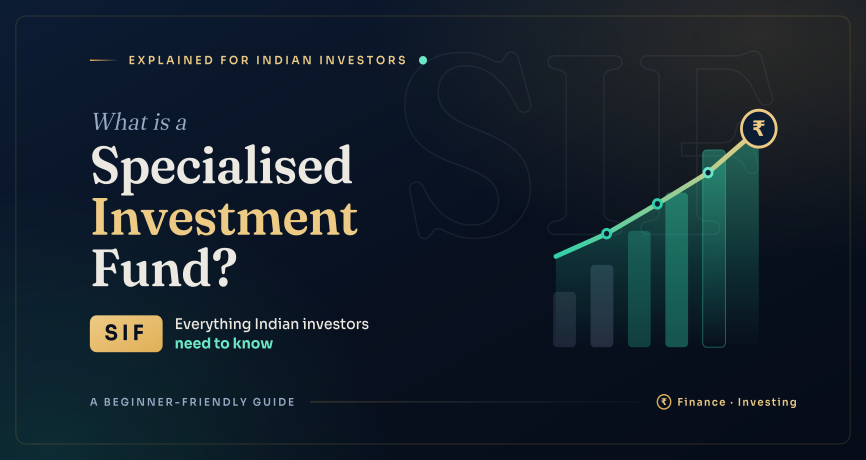
If you have over ₹10 lakh to invest and feel stuck between mutual funds (too generic) and PMS (too expensive at ₹50 lakh minimum), SEBI just created a middle path: the Specialised Investment Fund (SIF). Launched under the SEBI framework in 2025, the SIF is designed for sophisticated investors who want more customisation without crossing the PMS or AIF threshold. Here is everything you need to know.
What Is a Specialised Investment Fund (SIF) and How Is It Different from PMS and AIF?
An SIF is a SEBI-regulated investment product that sits between a regular mutual fund and a Portfolio Management Service (PMS). Minimum investment is ₹10 lakh per investor. Unlike a mutual fund, an SIF can follow more concentrated or specialised strategies. Unlike a PMS (minimum ₹50 lakh) or an AIF (minimum ₹1 crore), an SIF is more accessible to upper-middle-income investors and HNIs. It is NOT a regular mutual fund and carries higher risk and complexity.
SIF vs PMS vs AIF: Quick Comparison
| Feature | SIF | PMS | AIF |
|---|---|---|---|
| Minimum Investment | ₹10 lakh | ₹50 lakh | ₹1 crore |
| Regulatory Framework | SEBI MF Regulations | SEBI PMS Regulations | SEBI AIF Regulations |
| Portfolio Customisation | Moderate | High | Very High |
| Eligible Investors | Accredited/eligible | Affluent/HNI | Very HNI/Institutional |
| Liquidity | Moderate (periodic) | Moderate | Low (lock-in) |
Who Should Consider an SIF?
An SIF suits investors who already have a mutual fund portfolio as a core, have ₹10 lakh or more in surplus investable funds, and want exposure to more specialised strategies — such as specific sectors, factor-based investing, or alternative fixed income. It is particularly relevant for HNI clients in metros like Kolkata, Mumbai, Bengaluru, and Jaipur who are stepping up their wealth planning. It is NOT suitable for first-time investors or those without a high-risk tolerance.
Tax Treatment and What to Watch
The tax treatment of SIFs depends on the underlying portfolio — equity-oriented SIFs will likely attract equity capital gains tax, while debt-oriented ones will follow debt taxation rules. SEBI has mandated that only eligible or accredited investors participate in SIFs. Always consult a qualified financial advisor or Chartered Accountant before investing. This is a high-complexity product.
Disclaimer
Mutual fund investments are subject to market risks. Please read all scheme-related documents carefully before investing. Past performance is not indicative of future results.
This blog is for general financial education and awareness only. It does not constitute personalised investment, tax, legal, or insurance advice. Please consult qualified professionals for your specific situation.
Baid Inbest LLP is an AMFI-registered Mutual Fund Distributor. ARN: 86114. This content is for educational purposes only and does not constitute personalised investment advice.
Curious if an SIF fits your wealth plan? Talk to an Inbest advisor at www.inbestnow.com or call +91 99039 21999 for a confidential consultation.