Key Takeaways
- SIP is ideal for regular income earners — it removes the need to time the market.
- Lump sum carries market timing risk; use STP to mitigate it if you have a large corpus.
- Rupee cost averaging lowers your average purchase cost in volatile markets.
- SIP does NOT guarantee protection from losses — it reduces average cost, not market risk.
- Choose your strategy based on your income pattern and existing corpus, not market predictions.
Introduction
The Nifty 50 swung by over 15% in a single quarter in early 2026. For anyone with money to invest, one question dominates: should I start a SIP or invest a lump sum? The answer is not one-size-fits-all. Your income pattern, existing corpus, and risk appetite all matter. Here is a clear, honest breakdown to help you decide.
Is SIP Better Than Lump Sum Investment in 2026?
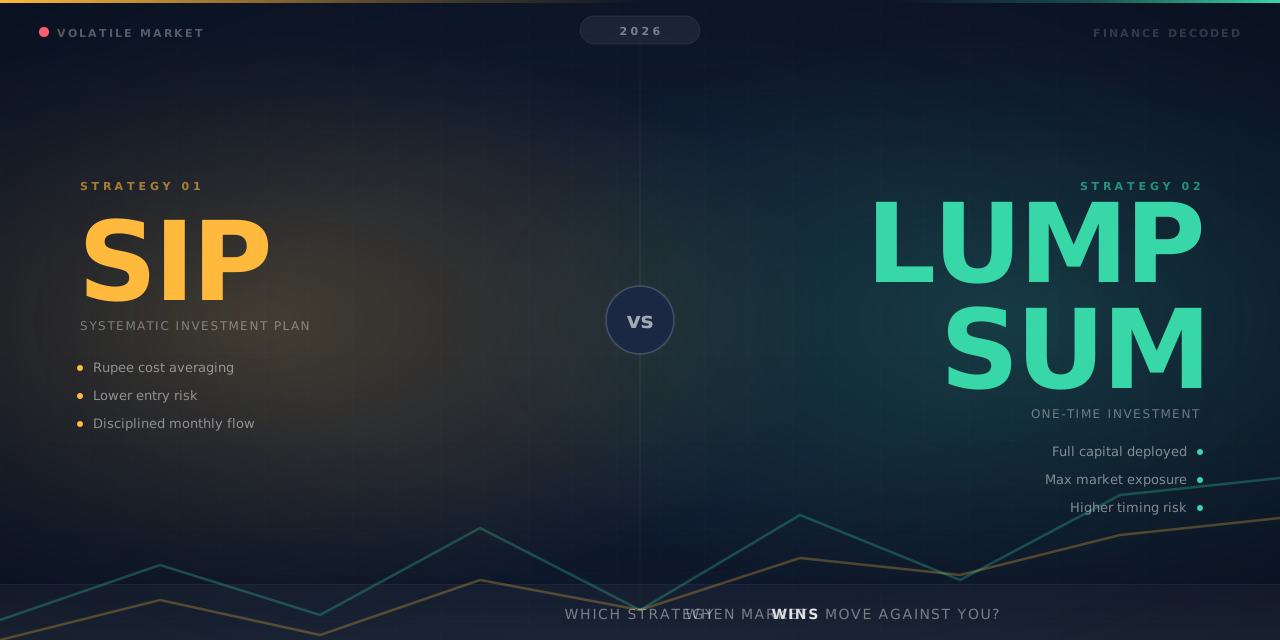
For regular income earners — salaried employees, freelancers, business owners with monthly cash flow — SIP (Systematic Investment Plan) is typically the smarter route in a volatile market. SIP uses rupee cost averaging: you invest a fixed amount every month regardless of market levels. When markets fall, your fixed amount buys more units. When markets rise, it buys fewer. Over time, your average purchase cost tends to be lower than the average market price.
Rupee Cost Averaging: A Simple Example
Let us say you invest ₹10,000 every month in a fund (illustrative, assuming 12% CAGR p.a.):
| Month | NAV (₹) | Units Purchased |
|---|---|---|
| Month 1 (market high) | ₹50 | 200 units |
| Month 2 (market falls) | ₹40 | 250 units |
| Month 3 (market low) | ₹35 | 285 units |
| Month 4 (recovery) | ₹45 | 222 units |
| Average NAV paid | ₹42.50 | 957 units total |
If you had invested ₹40,000 as a lump sum at Month 1 (₹50 NAV), you would have only 800 units. SIP gave you 957 units. This is the power of rupee cost averaging in a volatile market. All figures are illustrative only.
When Is Lump Sum Better? Introducing STP
If you have a ready corpus — say a bonus, inheritance, or matured FD — a full lump sum into equity carries timing risk. A smarter approach is STP (Systematic Transfer Plan). You park the entire amount in a liquid or overnight mutual fund, and then set up an automatic transfer of a fixed amount into your equity fund every month. This gives you the safety of a debt instrument while gradually building equity exposure — without the anxiety of picking the right entry point.
SIP vs Lump Sum vs STP: Quick Comparison
| Factor | SIP | Lump Sum | STP |
|---|---|---|---|
| Best for | Regular earners | Large one-time corpus | Large corpus, lower risk |
| Market timing risk | Low | High | Low to medium |
| Flexibility | High | Low | Medium |
| Ideal market condition | Volatile markets | Clear market uptrend | Volatile or uncertain |
Disclaimer
Mutual fund investments are subject to market risks. Please read all scheme-related documents carefully before investing. Past performance is not indicative of future results.
All financial projections assume 12% CAGR p.a. for equity mutual funds (illustrative only). Actual returns may be higher or lower.
Baid Inbest LLP is an AMFI-registered Mutual Fund Distributor. ARN: 86114. This content is for educational purposes only and does not constitute personalised investment advice.
Not sure whether to SIP or use STP for your bonus? Let Inbest help you decide — visit www.inbestnow.com or call +91 99039 21999.