Key Takeaways
Mutual fund returns can look confusing, but each metric has a clear purpose. NAV reflects price, not performance. Absolute return works for short-term investments, CAGR is ideal for lump sums, and XIRR is the most accurate measure for SIPs and irregular cash flows. Understanding the right return metric helps investors compare funds correctly and make confident, goal-aligned decisions.
"My mutual fund gave 45% returns!" your colleague announces proudly at lunch. You check your fund- it says 12% CAGR. Does that mean their fund is better? Should you switch? Here's the plot twist: You both might have invested in the same fund. They're just measuring returns differently. Most investors get lost in the alphabet soup of NAV, CAGR, absolute returns, and XIRR. But understanding these isn't just about sounding smart at parties- it's about making smarter investment decisions. Today, we're breaking down these concepts so simply that you'll never be confused again. Let's dive in.
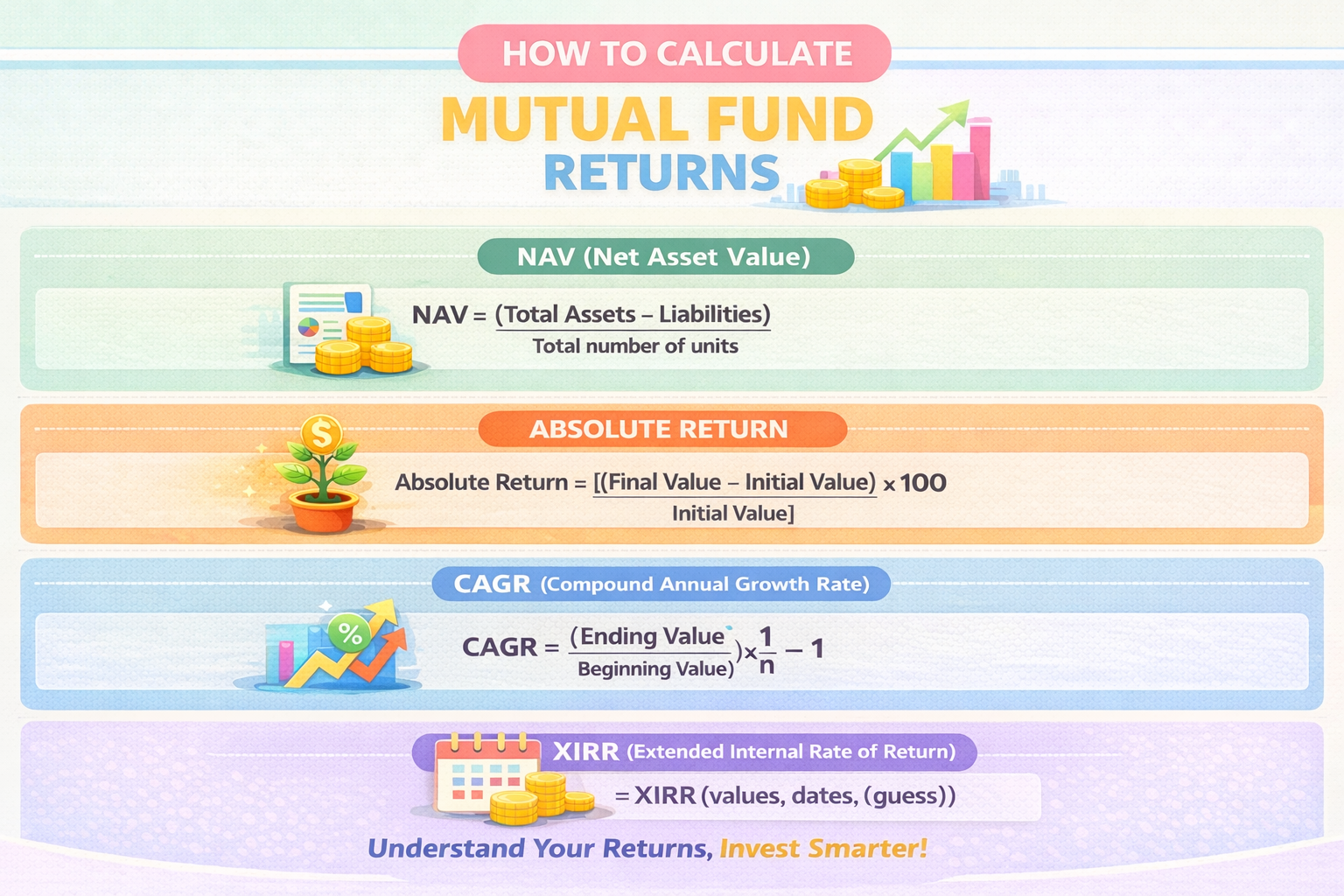
1. What Is NAV (Net Asset Value)?
NAV is the price of one unit of a mutual fund. Just like a share price, mutual funds also have a daily price which is called NAV.
Formula:- NAV = Total value of fund’s assets – liabilities / Total number of units
- NAV is declared once every business day after markets close.
- Fund A has NAV: ₹20
- Fund B has NAV: ₹200
Both can give the same percentage return. Returns matter, not NAV value.
When is the NAV Useful?- For Mutual Fund buying & selling.
- For understanding portfolio worth.
- For comparing fund performance
2. What Is Absolute Return?
Absolute return shows how much your investment has grown in percentage terms, without considering time.
Formula:Absolute Return = [(Final Value - Initial Value) / Initial Value] × 100
Example:- Invested: ₹1,00,000
- Value today: ₹1,25,000
Absolute Return = 25%
When is the Absolute Return Useful?- For investments held less than 1 year.
- For short-term comparisons.
- It ignores time, which can be misleading.
- Absolute return alone is not suitable for long-term investing.
3. What Is CAGR (Compound Annual Growth Rate)?
CAGR shows the annualized return of your investment over a period of time.
It answers that at what steady annual rate did your investment grow?
Formula:CAGR = (Ending Value / Beginning Value)(1/n) – 1
(where n = number of years)
Example:- Invested: ₹1,00,000
- Value after 5 years: ₹2,00,000
CAGR ≈ 14.9% per year
Why is CAGR Useful?- Best for lump sum investments.
- Ideal for comparing mutual fund performance.
- Removes short-term volatility noise.
CAGR assumes:
- One-time investment.
- No cash flows in between.
- That’s why CAGR does not work well for SIPs.
4. What Is XIRR (Extended Internal Rate of Return)?
XIRR is generally considered appropriate for calculating SIP returns as it accounts for multiple cash flows.
Formula:=XIRR (values, dates, [guess])
Example: (SIP Scenario)- SIP of ₹10,000 every month
- Markets fluctuate
- NAVs change
- Cash flows are irregular
XIRR calculates the real annualized return considering:
- Date of each investment
- Amount invested
- Final value
- Mutual fund statements
- Portfolio apps
- Advisor reports
- For SIPs, XIRR is commonly used because it reflects actual cash flow timing.
- Highly Sensitive to Cash Flow Timing.
- Not Ideal for Comparing All Investments.
- Assumes Reinvestment at Same Rate.
Which Return Metric Should You Use for Your Mutual Fund Investment?
If You Are a Beginner:
- Focus on XIRR for SIPs
- Don’t judge funds by NAV
If You Invest in Lump Sum:
- Use CAGR
- Compare funds with relevant benchmarks over longer periods (e.g., 5–10 years).
If Your Investment Is <1 Year:
- Absolute return is acceptable
- But avoid drawing conclusions
If You’re Reviewing Portfolio Performance:
- Always check goal-wise XIRR
- Compare with benchmarks
Final Thoughts: Returns Make Sense When You Understand Them
Mutual fund returns aren’t complicated, they’re just poorly explained. We hope this blog helps you in understanding these crucial key concepts of mutual fund investment, ensuring you move from a confused investor to a confident decision-maker. Connect with Inbest mutual fund advisors today to make informed investment decisions.
Disclaimer: Mutual fund investments are subject to market risks. Please read all scheme-related documents carefully before investing. SIP estimates and all comparison figures mentioned are purely illustrative. Past performance is not indicative of future results. Baid Inbest LLP is an AMFI-registered Mutual Fund Distributor (ARN: 86114). This content is for educational purposes only and does not constitute personalised investment advice. Please consult a SEBI-registered investment advisor before making investment decisions.