Key Takeaways
- Gig workers need a 6–12 month emergency fund — double the standard 3–6 months for salaried employees.
- PPF is the gig worker's EPF substitute — open one today if you are self-employed or freelancing.
- A 'base SIP + surplus STP' model handles variable income better than a fixed high-amount SIP.
- Independent health insurance and term insurance are non-negotiable — no employer provides these safety nets.
- Advance Tax is mandatory for gig workers with annual tax liability above ₹10,000 — missing instalments attract interest.
Introduction
India had approximately 7.7 million gig workers as of 2023-24, according to NITI Aayog estimates. That number is growing rapidly. But the financial planning ecosystem in India is built almost entirely for salaried individuals. If you are a freelancer, independent contractor, or platform-economy worker, your financial strategy needs a fundamentally different framework.
| Challenge | Salaried Employee | Gig Worker / Freelancer |
|---|---|---|
| Income | Fixed monthly — predictable | Variable — feast and famine cycles |
| Retirement savings | EPF mandatory — employer matches | No EPF; voluntary NPS or PPF only |
| Health insurance | Employer cover typically provided | Must arrange independently; full premium self-funded |
| Tax compliance | TDS by employer; simple ITR | Self-assessed tax; ITR-4 or ITR-3; advance tax mandatory |
| Emergency fund need | 3–6 months of expenses | 6–12 months — higher variability requires more buffer |
The Variable Income SIP Strategy
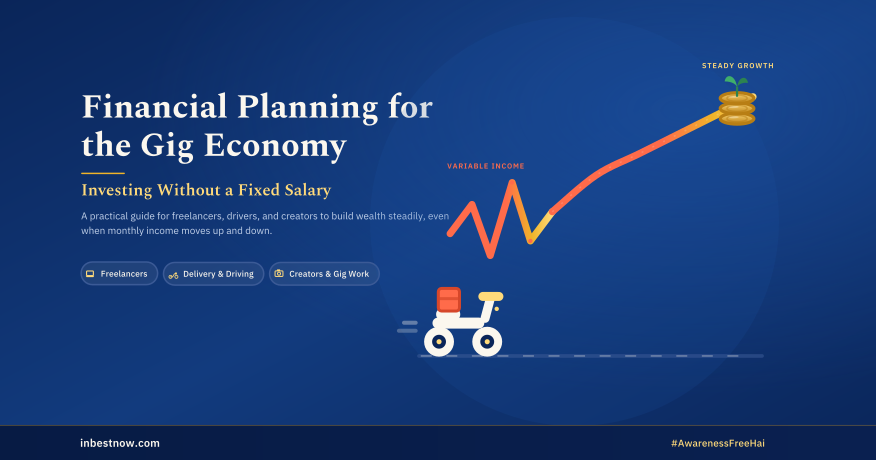
Fixed monthly SIPs are a challenge when income is variable. The practical solution: set a base SIP at a level you can sustain even in lean months (e.g., ₹3,000/month for someone earning ₹40,000–₹80,000/month). In good months, make an additional lump sum STP from a liquid fund — automatically deployed into equity at a pace matching your confidence. This 'base SIP + surplus STP' model works naturally with irregular income.
Priority Financial Actions for Gig Workers
- Build a 6–12 month emergency fund in a liquid fund — this is non-negotiable given income variability.
- Get independent health insurance immediately — no employer cover means any hospitalisation without insurance is a financial crisis.
- Open a PPF account — substitute for the EPF you do not have; guaranteed, tax-free, government-backed.
- Set up NPS Tier I — access the 80CCD(1B) ₹50,000 extra deduction available under the old tax regime.
- Pay Advance Tax quarterly — gig workers are frequently caught by 234B/234C interest for ignoring Advance Tax.
Disclaimer
Mutual fund investments are subject to market risks. Please read all scheme-related documents carefully before investing. Past performance is not indicative of future results. Baid Inbest LLP is an AMFI-registered Mutual Fund Distributor (ARN: 86114). This content is for educational purposes only and does not constitute personalised investment advice. Insurance is the subject matter of solicitation. Please read the policy terms and conditions carefully before purchase. Baid Solutions Insurance Broking Pvt. Ltd. is an IRDAI-registered Direct Insurance Broker (Reg. No.: 831). This content is for educational purposes only and does not constitute personalised advice.
Freelancer or gig worker building a financial plan? Inbest works with self-employed clients — visit www.inbestnow.com or call +91 9903921999.