Key Takeaways
Section 80C offers a powerful opportunity to save tax while building long-term wealth, and ELSS mutual funds stand out as the most efficient option. With the shortest lock-in, higher return potential, and SIP flexibility, ELSS suits most taxpayers. Starting early, choosing quality funds, and avoiding common tax mistakes can significantly enhance both tax savings and wealth creation.
Introduction
When it comes to the end of a financial year (March), every Indian citizen taxpayer has fear of those big deductions from their hard-earned money. If you are also a tax payee and want to save a substantial amount of your fund, then this blog will be a great relaxation for you.
This guide breaks down how to maximize Section 80C under the Income Tax Act, 1961, using mutual funds to save taxes while simultaneously building substantial wealth.
The Section 80C Golden Opportunity: ELSS Funds
Before diving into general taxation, let's address the most popular tax-saving investment for salaried Indians—ELSS (Equity Linked Savings Scheme).
What Makes ELSS Special?
ELSS mutual funds are the only mutual fund category offering tax deductions under Section 80C of the Income Tax Act.
Key Features:
- Tax deduction up to ₹1.5 lakh annually under Section 80C
- 3-year lock-in period (shortest among all 80C options)
- Minimum 80% equity exposure (high return potential)
- Potential returns: 12-15% historically
- No maximum investment limits
Tax Benefit Calculation:
If you're in the 30% tax bracket:
- Investment in ELSS: ₹1,50,000
- Tax saved: ₹46,800 (30% of ₹1.5 lakh + 4% cess)
- Additional wealth if invested instead: ₹46,800 growing at 12% for 20 years = ₹4.5 lakh+
This is like getting a ₹46,800 bonus every year for investing!
*Tax benefits are subject to prevailing tax laws and individual circumstances.
Why ELSS Wins the 80C Race:
- Shortest Lock-in: Only 3 years (vs. 5 years for tax-saving FDs and 15 years for PPF (Public Provident Fund)).
- Higher Return Potential: Since it invests in the stock market, it historically delivers 12–15% returns over the long term, compared to the 7–8% of fixed-income schemes.
- SIP Convenience: You don't need a lump sum; you can start with just ₹500/month.
When to Invest in ELSS?
Option 1: Start of Financial Year (April)
- Full year for wealth creation
- No March rushes
- Better compounding opportunity
Option 2: Lump Sum at Market Corrections
- If you can, time it right
- Maximize returns along with tax benefits
Option 3: Monthly SIP Throughout the Year (Best Approach)
- ₹12,500 monthly SIP = ₹1.5 lakh annually
- Rupee cost averaging
- Disciplined approach
- No stress about market timing
Choosing the Right ELSS Fund
Evaluation Criteria:
- Consistent Performance: Check 5-year and 10-year returns
- Fund Manager Track Record: Stability and experience
- Expense Ratio: Lower is better
- Portfolio Quality: Check top holdings
- AUM Size: Not too small (< ₹100 crore) or too large (> ₹20,000 crore)
Diversification Pro Tip: Invest in 2-3 ELSS funds to spread risk, not more.
Common Tax Mistakes That Can Hamper Your Money
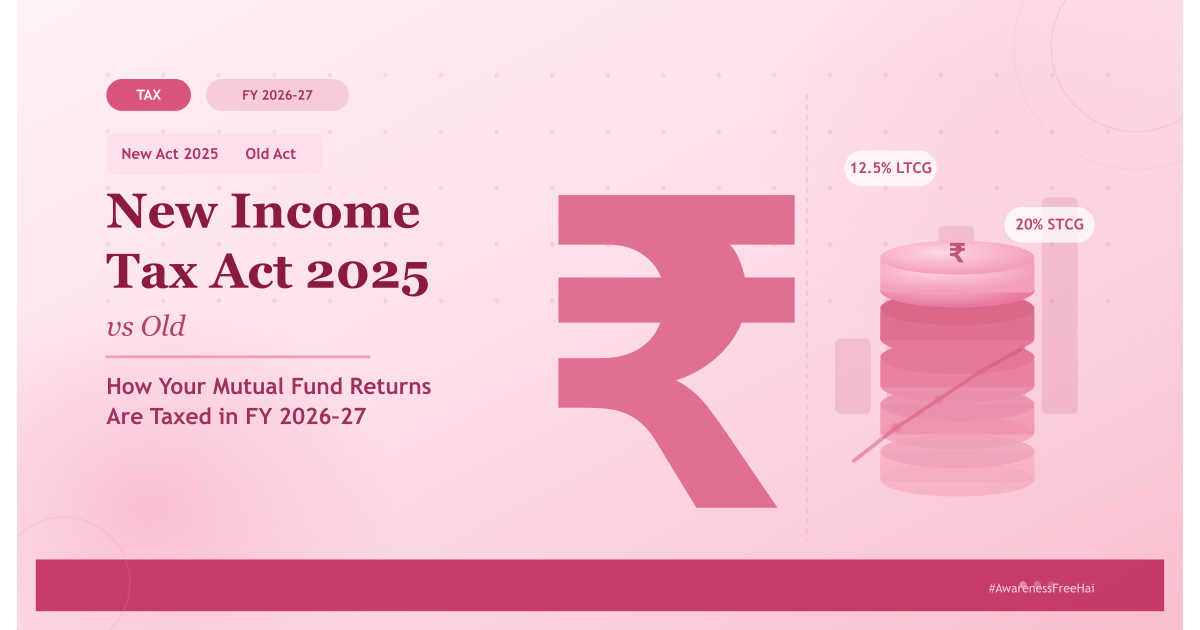
Mistake 1: Redeeming equity funds before 12 months costs you the difference between 20% STCG (Short-Term Capital Gains) and 12.5% LTCG (Long-Term Capital Gains). On a ₹1 lakh gain, that's ₹7,500!
Mistake 2: Not utilizing ₹1.25 lakh annual exemption. If you have ₹10 lakh in equity funds with ₹3 lakh unrealized gains, redeem and reinvest systematically to harvest tax-free gains.
Mistake 3: Choosing the dividend option in the high tax bracket. Growth option offers tax deferral and better compounding.
Mistake 4: Investing in debt funds without considering tax bracket. If you're in the 30% bracket, debt funds may not be optimal for goals beyond 3 years.
Conclusion: Don't Just Save Tax, Grow Your Wealth
Tax planning shouldn't be left among the year-end tasks, as the last-minute rush will only let you stand in the loss groups. Whether you are a young professional starting your first job or a seasoned investor rebalancing for 2026, the key is to understand how your specific tax slab interacts with your fund choice. Connect with Inbest to get the best advice on maximizing your wealth while utilizing the Section 80C tax benefits on your fund.
Disclaimer
Mutual fund investments are subject to market risks. Please read all scheme-related documents carefully before investing. SIP estimates and all comparison figures mentioned are purely illustrative. Past performance is not indicative of future results. Baid Inbest LLP is an AMFI-registered Mutual Fund Distributor (ARN: 86114). This content is for educational purposes only and does not constitute personalised investment advice. Please consult a SEBI-registered investment advisor before making investment decisions.